

 Employer Registration

- LocationSint Maarten, Netherlands
- SalaryDepends on Experience
- Vessel Length111' to 144' (34 to 44 meters)
- Vessel FlagMarshall Islands
If you are looking for yacht Mate jobs, Northern Europe is one of the best places to be. The region's well-developed marina network supports consistent crew demand across multiple seasons. It is drawing both private owners and charter management companies to its ports year-round. Jobs are available for crew at all levels, from entry-level positions on smaller charter vessels to senior roles on large private superyachts. Connect directly with employers hiring for yacht roles. Register, list your qualifications, and apply easily to live vacancies all in one place, with no intermediary fees or delays.
Modern yachts are intricate, sophisticated vessels that require advanced technical expertise to manage and maintain. A yacht engineer's main job is to guarantee that the boat's mechanical, electrical, hydraulic, and electronic systems operate properly. To ensure the safety and comfort of the crew and passengers, he is in charge of the systems' upkeep. If something acts up, he will have to repair and maintain it. Additionally, the yacht engineer needs to be able to identify and resolve any technical issues that can arise on board. His day-to-day duties cover several core areas:
A yacht engineer must possess seamanship and the required technical skills. The dual-role nature of this position commands a premium over a standard Deckhand. That is why this position is the hardest to fill, and you can find a lot of vacancies throughout the year.
There are different positions for yacht engineers. It starts with Junior Yacht Engineers who assist experienced engineers and learn how things work onboard. At the same time, the highest position is that of the Chief Engineer, who oversees all technical systems on board. On larger vessels, the Chief Engineer also manages a team of 2nd and 3rd Engineers plus the ETO.
Depending on the size of the yacht, the positions are categorised into four classes: Y1, Y2, Y3, and Y4. There are also other specialised engineering positions available, including MEOL engineer, AEC engineer, electrotechnic engineer, ETO engineer, 2nd engineer, 2nd engineer 3000gt-6000kw, 2nd engineer 3000gt-3000kw, and 2nd engineer 500gt-3000kw. The basic pay for these positions looks like this:
The size and propulsion capacity of the yacht determine your engineering credentials. Most part of these credentials adhere to the hierarchical evolution of the UK's MCA (Maritime and Coastguard Agency), such as:
Most Yacht Engineers transition from a land-based technical role to this position. If you are a diesel mechanic, electrician, or shore-based engineer, you are suitable for this role. First, complete your STCW and ENG1 medical, then take the AEC 1 (Approved Engine Course) to get started in the yachting industry. You will likely have to start as a Junior Engineer or 3rd Engineer on a large yacht to learn yacht-specific systems (AV/IT, hydraulics, and hospitality services) before progressing into the shoes of a yacht Engineer.
STCW Basic Safety Training and a valid ENG1 Medical Certificate are required for all yacht engineering roles. Beyond that, your certification level (AEC through Y4 to Y1) depends on the size and propulsion capacity of the yacht you want to work on.
Engineers are among the highest-paid crew members due to their technical expertise. Their salary ranges depending on the rank and their experience level, such as:
Yes. While engineering is often a year-round permanent role because boats need maintenance even without guests, hiring peaks occur during. That's why seasonal jobs are common.
Yes. STCW is a mandatory 5-day global safety standard covering firefighting, first aid, and personal survival, required for engineers just like every other crew member.
There are specialized crew agencies and websites that help you find and apply for yacht jobs online. You can easily create your digital profile on these platforms, like Meridian, by uploading your CV and relevant certificates. It also sends you the latest job alerts via SMS and email to keep you updated. Once you find the job description of your liking, easily apply through our One-Click Apply button.
Motor yachts need the most engineering support due to complex stabilizer systems, multiple generators, and heavy hotel loads (AC, watermakers). Meanwhile, sailing yachts often hire engineers who are comfortable with hydraulics and winches. Besides, explorers and charter yachts also hire Yacht Engineers.
Meridian has helped thousands of yacht owners, management companies, and recruiters find exceptional captains and crew for amazing yacht vacancies since Crew4Yachts was founded in 2006, continuing after its acquisition in 2020.
Beyond this, here are other reasons why you should use Meridian to jump-start your yacht career:
Posting job vacancies or searching our platform for experienced crew takes just a few minutes.
Join for free in under two minutes. Instantly get discovered by hundreds of employers hiring yacht crew, receive job alerts tailored to you, and apply for opportunities around the world.

Upload your CV to create your account. If you'd like, you can also add qualifications and references.
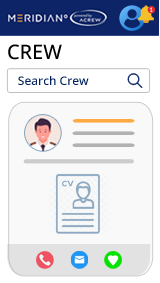
Employers can find and contact you directly using keyword search, just like Google.

Apply through our job alert emails or directly from our website.