

 Employer Registration
With every passing year, the yachting industry is expanding, but it is also becoming increasingly more selective and competitive for premium job opportunities. The good news is, it means more yachts, more marinas, and more jobs.
Landing a job has become a challenge with the growing number of applications yacht captains and recruiters receive. Most do not use savvy application tracking systems (ATSs), so when you do apply, your CV is actually seen.
To tackle this challenge, your CV becomes your first handshake and impression.
After all, before you ever meet a captain or step onto a yacht, your yacht CV does the talking. If you hold the right one, it can land you your dream job. Hold the wrong one? It gets buried.
Here’s the good news! Follow our instructions below, and you will feel confident crafting a new superyacht CV in 60 minutes that gets noticed, remembered, and shortlisted.
Don’t want to start from scratch? Need a CV Template that captains and recruiters love receiving? Visit our website and select from over 30 yachting CV templates.
Step-by-Step: Build Your Yacht CV in Under 60 Minutes
To make a self-talking yachting CV, you don’t need hours of formatting or writing experience. You can make it within one focused hour (60 minutes), or even faster if you use one of our CV Templates.
Let’s break it down into 10-minute sections
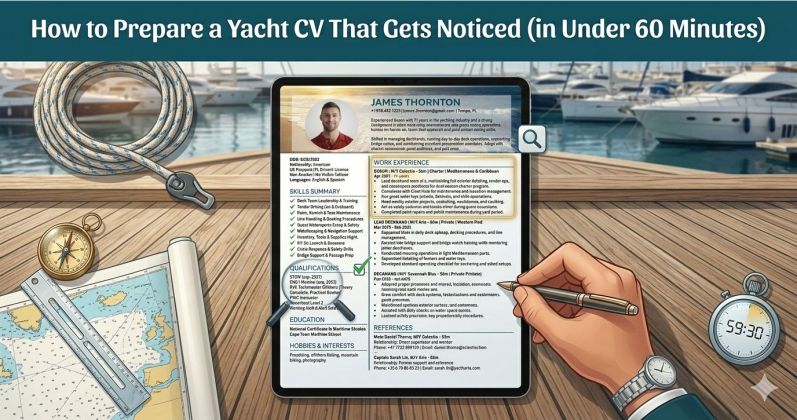
Minute 1-10: Basic Info & Contact Details
You need to start with the essentials. This section may seem simple, but it's the foundation of your CV. Missing any detail here can cost you the job.
Include the following:
- Full name
- Nationality
- Date of birth
- Passport and visa status
- Current location
- Contact number and email
- Availability to join
Pro tip: Do not forget to include a professional, passport-style photo. Keep it with a clean background, well-groomed, and ideally in uniform or neutral attire.
Minute 10-20: Write a Strong Objective or Personal Profile
This is where you introduce yourself (in just 2-3 sentences). This is the first thing captains or recruiters read after your basic info, so make it count.
Focus on who you are, what you bring, and what you’re aiming for. Keep it professional, confident, and warm.
Pro tip: Avoid clichés. Let your personality shine through while showing your commitment to yachting.
Minute 20-30: List Qualifications & Certificates
In yachting, certifications are not optional. They are your passport to the world. This section is often skimmed, so list each certificate clearly with its full name and expiration date.
Include essential certifications:
- STCW Basic Safety Training
- ENG1 Medical Certificate
- Powerboat Level 2
- Food & Hygiene Level 2 (for interior roles)
- PDSD or Security Awareness
- Additional skills (Diving, Massage, Yoga, Drone, Social Media, Singing, Dance, Fishing, etc.)
Make this section easy to scan (bullet points work best).
Pro tip: Always include expiration dates. Don’t make the recruiter second-guess the validity. A missing or expired certificate can immediately disqualify your CV from consideration.
Minute 30-40: Detail Work Experience
These 10 minutes are for the practical value you bring with your experience. List your experience in reverse chronological order (starting with your most recent role).
For each job, mention:
- Vessel name and type (e.g., M/Y Infinity, 75m private)
- Position held
- Dates onboard
- Key responsibilities and highlights
Pro tip: Highlight your charter experience, longevity, and range of duties. Captains look for proven, adaptable crew members.
Minute 40-50: Skills, Hobbies & Languages
Use this time to make your yacht CV more memorable to captains and recruitment agencies. Focus on both technical and soft skills that are valuable onboard.
Examples of what to include:
- Technical skills: Line handling, varnishing, AV/IT troubleshooting, tablescapes, sommelier, silver service, cocktail making, etc.
- Soft skills: Teamwork, time management, guest communication, and adaptability.
- Hobbies: Diving, yoga, photography, water sports, and fitness.
- Languages: Even basic conversational skills can be a plus.
Pro tip: Captains often look for well-rounded individuals who can jump into guest-facing and team roles with equal ease.
Minute 50-60: Final Formatting & Proofreading
So, you’ve done the hard work. Now, it’s time to make sure it looks polished and professional. A clean layout makes your CV easier to read and shows attention to detail (a trait every yacht crew member needs).
Do the following:
- Keep the CV to one page only if possible, but two pages is acceptable.
- Use clear headings and consistent formatting.
- Export as a PDF to preserve the layout.
- Name your file professionally. For example: FirstName_LastName_YachtCV.pdf
Pro tip: Do a final spell-check, check for consistency in fonts, font size, word spacing, line spacing, and double-check your contact details.
Common Yacht CV Mistakes to Avoid
Even a strong candidate can get overlooked due to small but critical CV mistakes. Here are some of the most common errors that turn captains and recruiters away:
- Using a generic resume format not tailored to the yachting industry.
- Forgetting to include expiration dates on certifications.
- Inconsistent formatting or mismatched fonts and headings.
- Typos or casual language (forgetting this is a professional document).
- No photo, or using an unprofessional image, like selfies, group shots, or vacation pics.
Pro tip: Your CV is your first impression. Sloppy presentation, missing details, or the wrong tone can sink your chances even if your experience is great.
Conclusion
A well-crafted yacht CV is more than just a list of qualifications. It is your gateway to stepping on board the right vessel. With 60 minutes and the right resume template, you can build a strong, professional CV that not only gets you noticed but also shortlisted and hired.